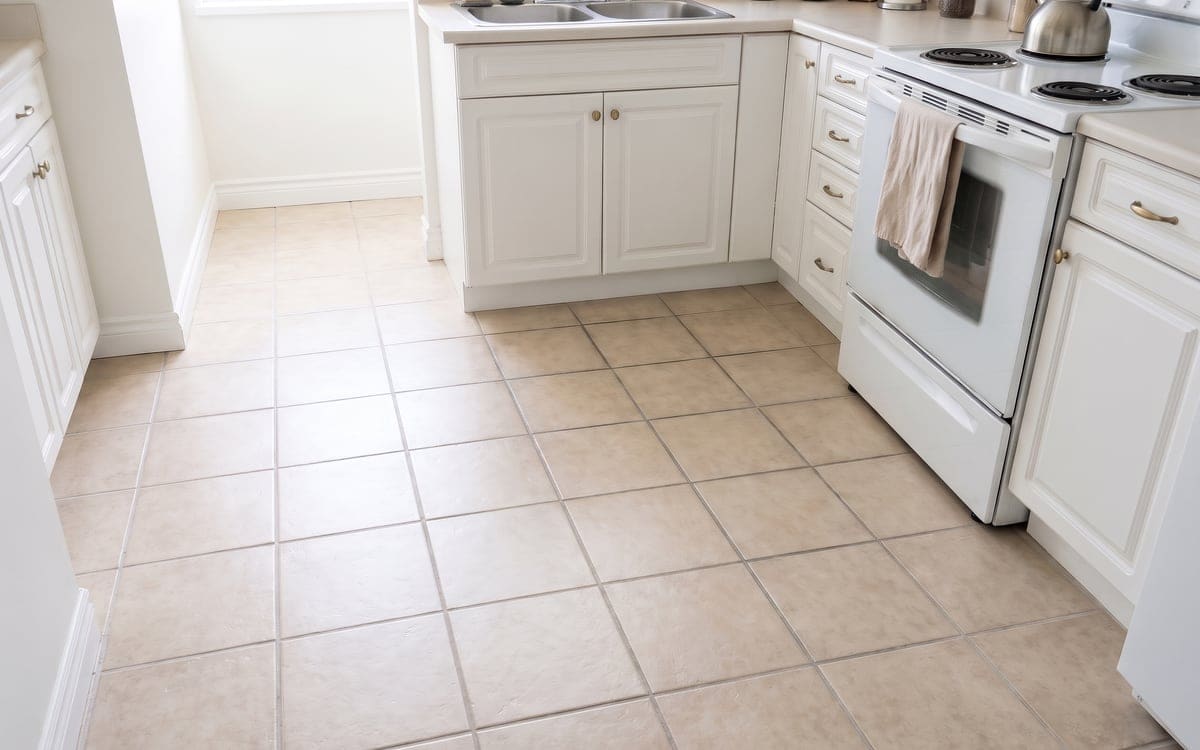
Grout is porous and sits lower than the tile
Grout is a mix of cement and fine aggregate, troweled into the gap between tiles and tooled down a little below the tile surface. That recessed line is where mop water pools after the mop goes past, and where small soil, hair and crumbs settle in a kitchen or a bath.
The porous side is the other half of the problem. Tile glaze is a glass surface; nothing really soaks into it, and whatever lands on tile wipes off easily. Grout is cement; it has small pores through its whole thickness, and liquid that sits on it works into those pores. That is why a drip of coffee lifts right off a tile but leaves a brown shadow in the grout next to it.
Mop water carries soil into the lines
A dirty mop makes grout darker, not cleaner. Mop water picks up soil from the floor on the first few passes, and after that the mop is spreading dirty water across the tile rather than lifting clean water off it. The soapy residue on top of that dries into the grout lines and holds the color of whatever was in the water.
A few habits in a home kitchen or bath make the problem worse over time:
- A string mop with no clean rinse step. Each pass puts dirty water back onto the floor and most of it drains into the grout lines, which stay wet for a while after the tile surface dries.
- Thick household cleaners used at full strength. A heavy soap residue traps dirt in the pore structure and lifts out less well than a thin, well-rinsed cleaning does.
- Letting a dirty bucket sit, so the next clean round starts with yesterday's mop water.
A plain damp mop, with water changed when it clouds, and a plain rinse pass before the floor dries, slows the pace at which the grout darkens. For what is already there, a careful deep cleaning of the lines is a different step, and that part is a cleaning rather than a mop. Tile and grout cleaning is the service that handles it.
Kitchens, entries and bath floors darken first
The kitchen leads on grout darkening. Cooking oil in the air settles on everything, drops of food and coffee hit the grout before anyone wipes them, and the stretch of floor in front of the sink and the stove gets more passes than any other tile in the home. An entry hall with a tile floor is close behind: grit tracked in from the street and dust from a windy day spill over onto the tile from the entry mat, and the grout lines next to the door hold what the mat does not catch.
Bathroom floors darken for a different reason. Soap, shampoo and conditioner all end up at the mat and in the shower runout, and soap residue in a grout line is a trap for lint from towels.
| Where grout darkens | What settles there |
|---|---|
| Kitchen, in front of the sink and stove | Cooking oil, food drops, coffee splashes |
| Entry mat and the step inside the door | Tire grit, dust from the street, tracked oil |
| Bath mat and shower runout | Soap residue, hair and lint on top of that |
| Pet food bowls | Food, water drips, dust from kibble |
| Trash can shadow | Drips from a bag, dust from under the lid |
Hard water varies across the city
Hardness in Los Angeles varies by water source. The LADWP 2025 testing1 averages hardness at about 103 mg/L in Los Angeles Aqueduct water and 234 to 236 mg/L in Metropolitan Water District water from its Weymouth and Diemer plants.
Hard water can cause mineral buildup in plumbing, fixtures and water heaters, and makes soaps and detergents work less well.2
What a deep cleaning can bring back
A deep cleaning of grout lines is different from a mop. The cleaner needs time to work in the pores, the agitation reaches into the recessed line, and the rinse is run so the dirty water does not go back into the pores as the floor dries.
What that lifts is the embedded soil in the pore structure of the line. A cleaning does not seal the grout, which is a separate step. The services hub covers what we handle and what sits with other trades.
Cracked or missing grout is a tile installer's job
A cleaning cannot fix grout that is cracked, chipped out or missing from the line. A grout line with crumbs of grout coming out of it has lost its seal between tiles, and a floor with those lines gets water underneath. The right sequence is a tile installer first, a cleaning after.