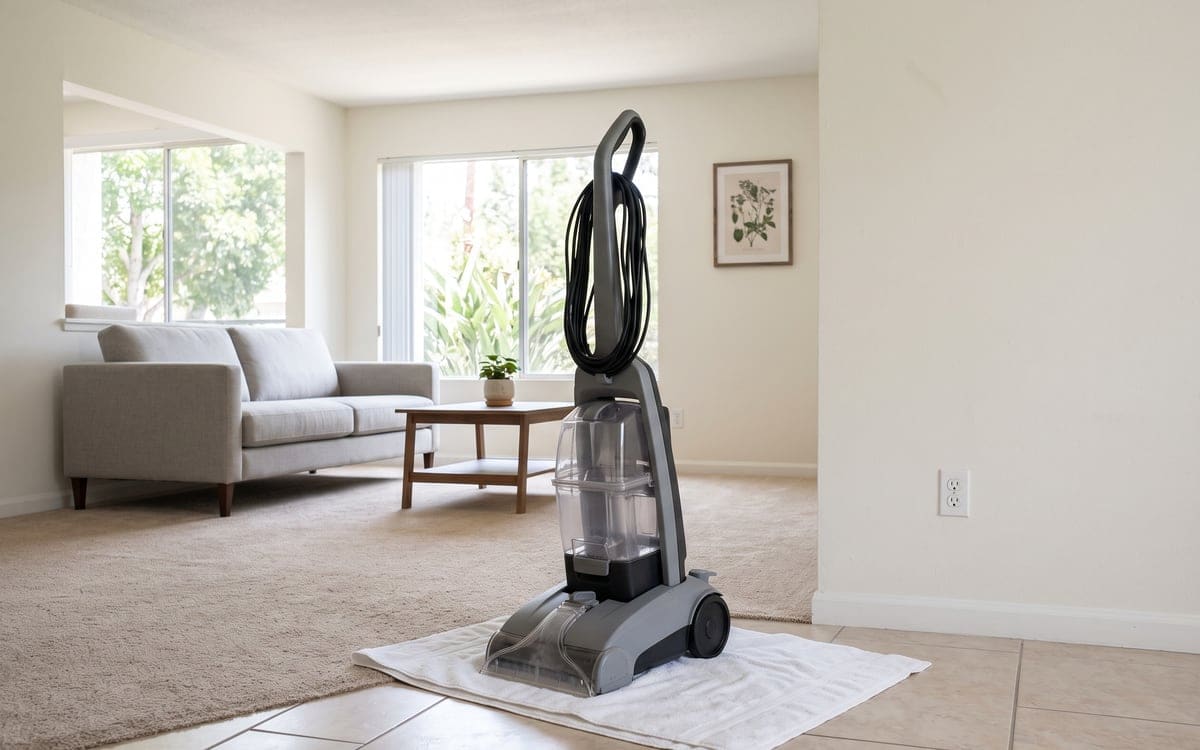
A rented machine is a small upright that sprays and pulls back
The machines you can rent from a hardware store or a grocery store are home carpet cleaners. A clean-water tank on the body holds warm water and the detergent the store sells with the machine. You push the handle to spray the carpet, then push the lever a second time to pull the dirty water back into a second tank. The pattern is the same one that professional extraction uses, in a smaller package.
Size and suction are the main differences between a rented upright and professional extraction. A rented upright is light enough to put in the trunk of a car. Professional extraction uses larger tanks and more suction, so more water comes back out of the carpet on each pass.
What it does well: a light refresh or a small area
A rented machine fits a job where the carpet is mostly fine and the goal is a refresh. A bedroom in a condo that has not had anything spilled on it, a hallway that is dull but not stained, the small corner where somebody tracked in mud: these are jobs a careful home user can handle. Light soil comes up with careful work, and the room comes back cleaner than it was.
A fresh spill you knocked out with towels an hour ago is another job that fits. Blot first, add a little plain water, blot again, then run the machine over the damp area with the trigger off to pull more out.
Where it falls short: less water comes back out
The one thing a rented upright does less well is pull water back out of the pile. The suction is weaker and the opening is smaller, so more of the water you spray stays in the carpet after each pass. Over a bedroom, you may not notice. Over a living room where the machine has gone over the same spots many times, the water adds up fast. The pile stays damp longer, the backing stays damp longer, and the pad underneath holds on to the rest.
A wet pad is where cleaning problems start. Fibers that cleaned up fine can wick stains back from a soaked pad as the carpet dries, so a spot that looked gone can show up again. Soap left behind can also pull soil back to the same place once the carpet is used again.
The habits that soak a pad
A few habits turn a careful rental into a wet pad.
One is pouring water or cleaner straight onto the carpet. The machine is built to meter a thin layer of water into the pile with each trigger pull. A cup of water from a bottle goes into the pad without any help, and the machine has to pull it out through a smaller opening than it can.
Running the spray over the same area again and again until the stain is gone also puts too much water in. Each wet pass loads more water into the pile; if a spot has not lifted, more water is rarely the answer. More agitation, more blotting with towels, or a professional look at it fits better than a run of wet passes.
Skipping the dry passes at the end leaves what water did go in sitting there. After the last wet pass, the trigger stays off and the machine runs over the same path to pull more water out. That step keeps the room from staying wetter than it needs to be.
Cords, water and stairs
A rented carpet cleaner is a wet appliance running off a cord. The habits around it are the same as any wet appliance with electricity: keep the two apart.
Run the cord along a wall and plug it into an outlet behind the furniture, not across the open floor where you have been working. Unplug the machine before you fill or empty the tanks. Keep the cord off wet carpet while you are working.
Stairs are their own story. These machines sit on a flat floor, and the attachment hose for a stair tool is where you cover the risers and treads, with the machine on the landing above or below the stairs and the hose coming up to meet you.
Apartments: carrying a machine and buckets up to the unit
About 48 percent of the city's housing units1 sit in buildings of five or more units. Renting a machine for an apartment adds logistics the picture at the store does not show. The machine comes home in a trunk, then goes up: in an elevator or up the stairs. The clean water goes up with it and the dirty water comes back down.
A couple of trips to the car is manageable. A long open walkway between the unit and the stairwell is longer than it looks. In a studio where the only tap is in the bathroom, you may be carrying buckets through the carpet you just cleaned.
When hiring makes more sense
A rented machine fits a light refresh. A hired steam cleaning fits the jobs where you want more water pulled back out of the carpet or where the soil has been there for a while.
A rented machine or a hired cleaning
A rented machine handles some jobs well. Others need more water pulled back out than it can manage.
A rented machine
- Fine for a light refresh or a small area.
- Less water comes back out, so go easy on wet passes.
- You carry it, fill it and empty it.
A hired cleaning
- Suits urine in the pad, wool rugs and couches.
- More water comes back out of the carpet.
- The crew brings the gear and does the work.
A dog spot that reached the pad, a hallway with gray lanes built up, a living room before a move-out, an old spill where the color has set: all push past what a home upright can finish. Professional extraction pulls more water back out and sends more rinse through the pile, so the pad ends up in better shape. Urine in the pad is where the gap is biggest, since flushing the backing takes more rinse than a rental holds and more suction than it has.
The couch is another place to hand off. A rented upright is not built for upholstery; even with the handheld attachment, the suction is low for a cushion. The couch is cleaned with upholstery tools made for fabric, not with the wand built for wall-to-wall carpet. Wool, viscose and silk area rugs stay off a rented machine too, and a wool rug starts with a fiber and dye check the hardware store cannot do for you.
| Job | A rented machine | A hired cleaning |
|---|---|---|
| A bedroom with light soil | Fine, with careful work | More than you need |
| A hallway with built-up lanes | Marginal; many wet passes | Fits well |
| A fresh pet spot caught early | Fine, after blotting first | More rinse through the pile |
| An older dog spot in the pad | Not enough suction to flush the pad | The right call |
| A couch or chair | Too much water, too little suction | Upholstery tools made for fabric |
| A wool or silk area rug | No; the fiber and dye check comes first | Yes, in place or at a rug plant |
| A move-out across a whole apartment | Possible, with careful work | More rinse pulled back out |
| Tile and grout | Not what the machine is for | A separate setup from carpet |
What to ask before you rent or hire
For a rental, ask the store what the machine does on heavy soil and whether the attachment hose fits stairs or furniture at your place. Read the detergent label before you fill the clean tank, and leave anything on the shelf that is not meant for a carpet cleaner. Mix nothing with anything else, in the tank or outside it; the fumes from mixed cleaners can be dangerous, and bleach or peroxide can take color out of the carpet in a stripe.
For a hired cleaning, ask what the crew does on your kind of carpet and how the price is set for the rooms, stairs and spots. Describe the rooms, the stairs, the carpet and the spots when you call. What a hired cleaning costs to set up walks through the drivers behind the number.
If you are in between, a cleaning is sometimes the lower-risk way to go, especially in a home with a pet or where the carpet has not been cleaned in a while. A rental is harder to undo once a pad is soaked.