Nearly half of the city's housing is in buildings of five or more units
Apartment carpet in Los Angeles is common. Census data shows about 48 percent of the city's housing units sit in buildings of five or more units, with about 17 percent in buildings of 50 or more,1 and 68 percent of the city's renter households live in buildings of five or more units, with about 14 percent renting a detached house.2
Apartment carpet cleaning starts with the building before the carpet.
Parking and the loading zone
Parking is the first question for an apartment cleaning. Where parking works on your block or at your building is a useful thing to raise when you call.
Buildings with a loading zone or a short-term visitor spot near the entry are the simplest. On a permit-only block, a visitor pass from the manager, a nearby meter, or a cross-street without permits is useful to mention; so are the hours on any time-limited meters. The setup that needs the most planning is street parking without close access to the building door.
Stairs, elevators and long hallways
An upper floor adds the question of stairs or elevator. The building sets which one is used; the manager's answer is what to tell us when you call.
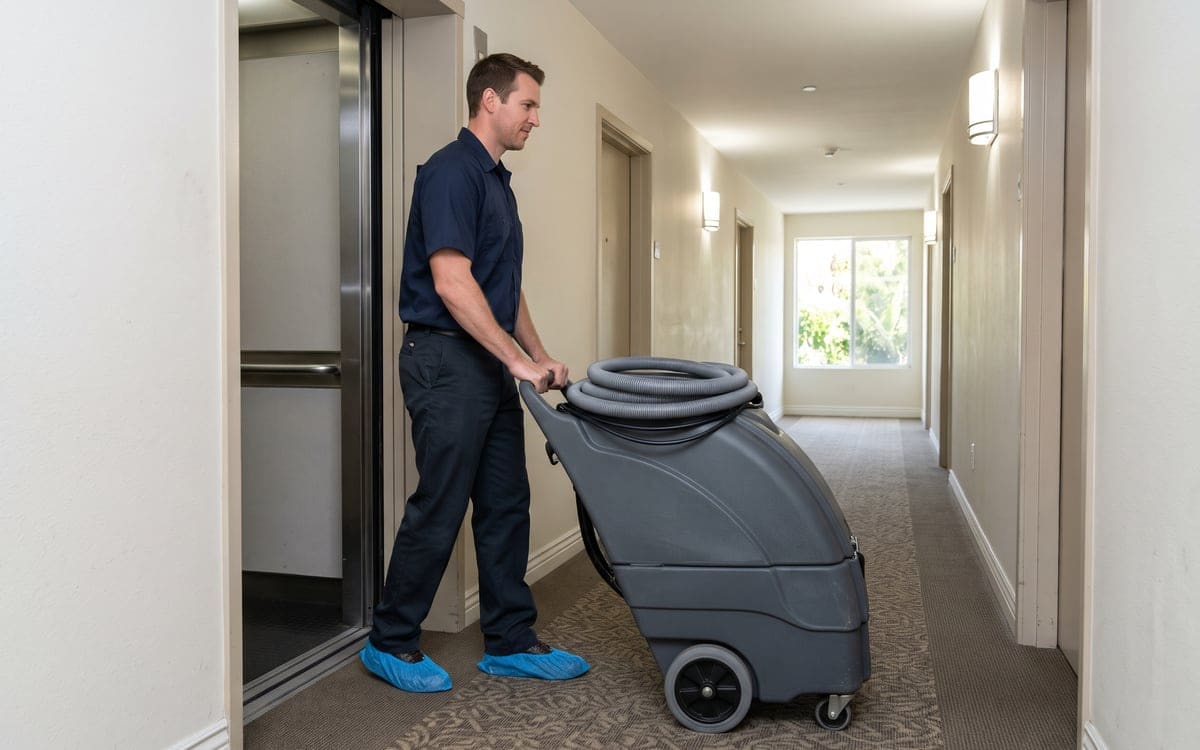
A service elevator may need a reservation for a cleaning visit. Where the only elevator is a passenger car, the manager often wants a pad set up on the walls or a specific window of hours. In a walk-up, the stair run is the route. Some buildings also ask that no equipment be dragged across a hallway runner.
Building rules and the manager
Buildings keep their own rules. Check with the manager a day or two ahead on:
- Does the building need advance notice for a service vehicle at the door?
- Is there a loading dock or a service entrance to use instead of the front lobby?
- Are there hours when the building prefers a cleaning visit (quiet-hours rules, trash-day conflicts)?
A manager that has been through a few of these has the answers at hand. Either way, that call is yours to make a day or two ahead; tell us what the manager said.
Small units, room by room
About 66 percent of the city's housing units have two bedrooms or fewer, including about 180,439 studios.3 An apartment carpet cleaning in a small unit covers a few rooms (a living room, a bedroom, a hallway), and the work goes room by room rather than wing by wing.
Rooms are one of the things that move the price, which the carpet cleaning cost guide walks through. Pet spots, traffic lanes and spills behave the same way they do in a house. Pet carpet cleaning covers what reaches the backing; carpet steam cleaning covers the lane and spill work.
Courtyard buildings and older walk-ups
Los Angeles has building types that take their own planning. The dingbat is a stucco box apartment of 1954 to 1968, once common across parts of the city.4 The bungalow court is a multi-family type found throughout Los Angeles, mostly in Craftsman and Spanish Colonial Revival styles from the 1910s and 1920s.4
Each one puts a different question onto the call. Ask the manager where a service vehicle can sit, and whether a service elevator or a loading area is on site. Mentioning the building type on the call tells us what to plan for.
| What to say on the call | Why it helps to know |
|---|---|
| The building type and the floor | Shapes the plan from the street in |
| Loading zone, visitor spot, or meters | Tells us where parking works |
| Elevator or walk-up | Sets the route from the lobby to the unit |
| Any manager rules or hours | Fits the visit inside the building's day |
| Rooms, stairs, closets | Scopes the walk-through |
| Pet spots and traffic lanes | Scopes the work on the pile |