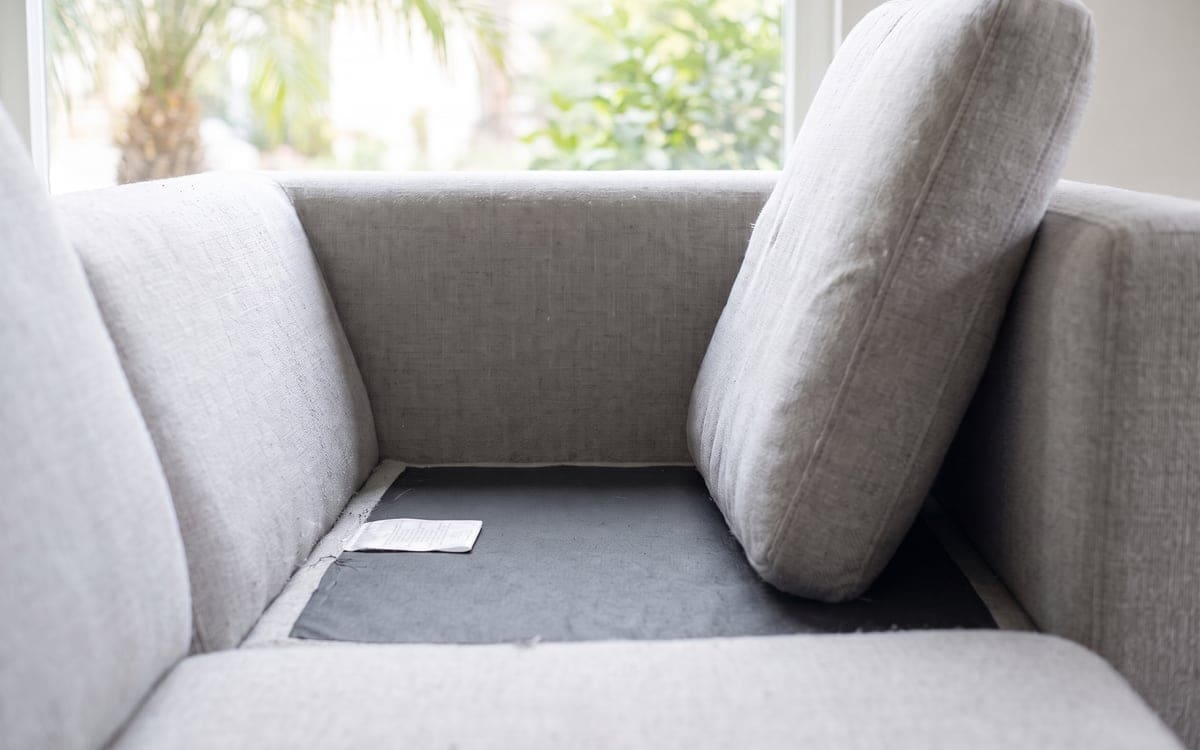
Every couch has a maker's tag
The maker's tag is often under a cushion. Pull a seat cushion out and look at the strip of frame underneath; flip the cushion itself and look at the fabric underside. On some sofas, the tag is sewn on the underside of the frame skirt. Where the tag sits is a question for the couch, not a rule.
If a couch has no tag at all, there is still a way through. Some older sofas never had one. Some tags came off at a reupholstering. In those cases, the test spot takes on more of the weight, and the plan for cleaning is more careful.
Read the tag before anything touches the fabric
Reading the tag covers what the maker names: a method to use, a method to avoid, any note on color-fastness or shrinkage, and any mention of a backing or a stain-repellent treatment that would change the cleaning. All of that comes before any water or any cleaner.
If the tag has worn off, is unreadable, or was never there, the home step stops at blotting with a dry towel and the couch is left for a cleaning visit.
The cleaner tests a hidden spot before anything touches the fabric
Every couch cleaning starts with a hidden test spot run by the cleaner, not by the reader. The test spot is a small area in a place the eye does not go: under the frame apron at the back, behind a leg, or under a seat cushion where the cushion covers it when the couch is dressed. A small amount of the cleaning solution on a white cloth is pressed onto the test area, then lifted and looked at.
The test tells us whether the fabric is giving up color onto the cloth, and whether the weave changes texture under the solution. A clean test spot lets the cleaning go ahead; a test spot that shows a change changes the plan.
On a leather, a suede or a boucle, the finishes vary piece to piece and the test has more to look at. The couch page covers the walk-through where the test fits in.
Why some fabrics shrink, spot or bleed
A fabric that was not tested first can shrink when it gets wet, spot where water dries unevenly, or bleed color onto itself. A cotton or linen weave that was tight to begin with can go a step tighter with water, so a loose cushion cover no longer fits. A rayon or a silk blend can show a ring where the wet area met the dry area even after the whole couch dries. A couch with a cream base and a navy pattern can show the navy running into the cream on cleaning day; a red velvet can give up red to a damp cloth. The test spot catches most of this, and a tag that warns against water catches the rest.
| Tag or fabric situation | What the cleaner does first |
|---|---|
| Readable tag with a method named | Tests a hidden spot before running the named method |
| Readable tag with a water warning | Plans a dry method only, after a hidden spot test |
| No tag at all | Tests a hidden spot; the home step stops at a dry-towel blot |
| An old reupholstering | Tests a hidden spot regardless of what the tag now says |
| A note about color-fastness | Tests a hidden spot before any cleaning |
| A separate backing or coating | Checks the back of a cushion cover |
Leather and suede are their own case
Leather is skin with a finish on it. Suede is the inside of that skin, raised to a nap. Neither cleans like a woven fabric, and both are a cleaning rather than a wipe-and-done. A separate guide on leather couch cleaning covers what a leather couch needs.
A test spot on leather tells us whether the finish is sealed and shiny or soft, matte and inclined to drink in water. Each cleans in its own way. On suede, water is almost never the move; a dry method with a brush is the usual plan, with the piece checked carefully for discoloration before anything else.
When to leave it for a cleaning
A couch becomes a cleaning call rather than a towel call when a spill reached the cushion through the top fabric, since there is residue in the foam that a towel on top will not reach. The same is true for a spot on a fabric the tag warns about, where a careful cleaning is safer than a store product. The other case is a couch that has been through enough use that a general cleaning is overdue, with marks on the arms, a flattened pile where the family sits most, or a smell that has settled into the cushions.
A spill in the first few minutes is still worth blotting with a dry white towel. Press down, do not rub. Stop there, and leave the pouring and the pressing to a cleaning. The stain removal guide covers the towel step. Past that, a cleaner runs the hidden test spot before anything else.