Urine goes past the fibers into the backing and the pad
A fresh spot on carpet is not a stain only on the pile. The pile is the top layer; a backing sits under it, and under that is the pad. Urine that sits on the carpet for even a short time soaks through the pile, through the backing and into the pad. Older spots can reach the subfloor underneath.
What stays in the pile cleans up on top. What soaked into the backing and the pad is where the smell lives, and that part a towel on the surface cannot reach. When the carpet looks clean again, the residue is still underneath, and the smell can carry back up into the room.
Why the smell comes back after a spot is cleaned on top
A cleaning on the pile only cleans the pile. The residue in the backing and the pad is still there after a surface wipe, and the smell can carry up through the fibers as the room warms and cools through the day. That cycle is the telltale sign that the pad is where the problem sits.
A dog that smells its old spot often marks the same place again, which puts fresh urine on top of residue that was never flushed out. Each round widens the spot and adds to what the pad is holding, and the smell gets stronger as that goes on. A cleaning that flushes the backing and the pad is what gets ahead of it. Pet carpet cleaning is the service that does the flushing part.
The first minutes: blot, a little plain water, blot again
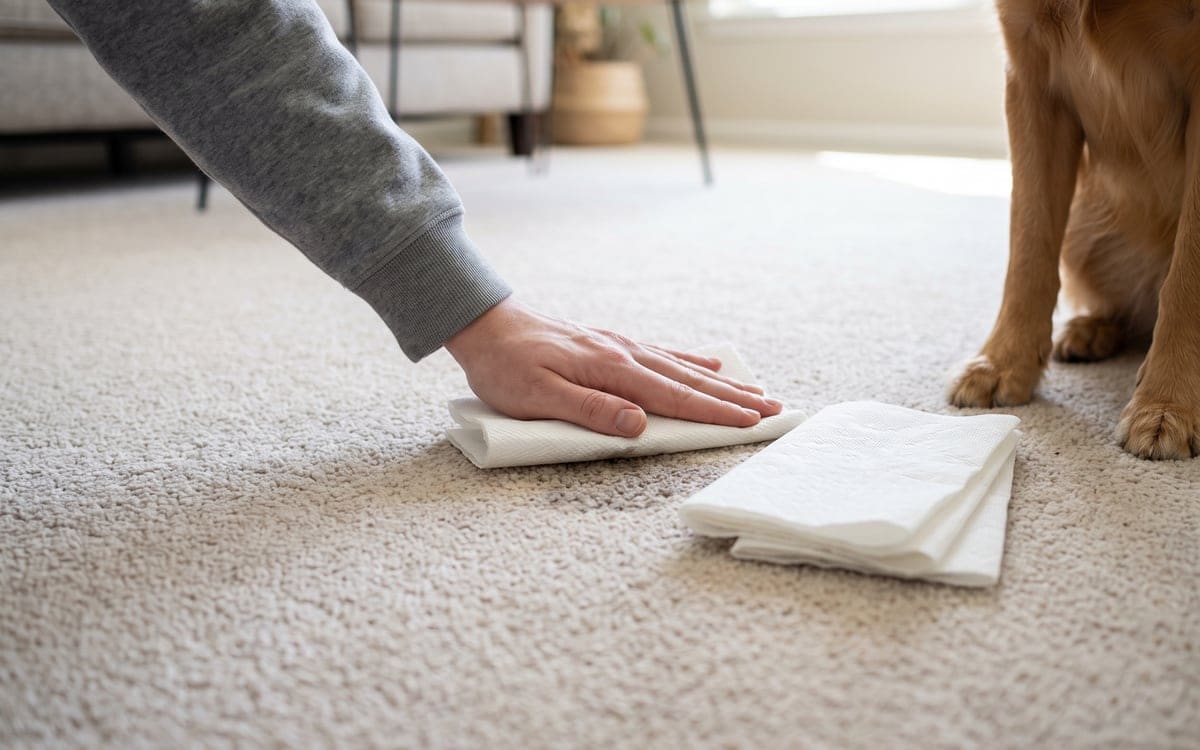
A dog spot is easier to lift in the first few minutes, before it has a chance to reach the pad. The steps are simple and the tools are towels and water.
Right after the dog has an accident
The aim is to pull as much out as you can before it reaches the pad.
Blot with paper towels
Lay a stack of paper towels on the spot and stand on them for a moment.
A little plain water
Dampen the spot lightly to thin what is left.
Blot until dry towels stay dry
Swap in fresh towels and keep pressing.
Mark the spot
Remember where it was so it gets attention at the next cleaning.
A folded white towel on the spot comes first. Press straight down, do not rub, and stand on it for a moment to put weight into it. Lift it and look at the towel; if it is wet, swap in a dry one and press again. Keep going until a dry towel comes up almost dry. Then dampen the spot lightly with plain water, and go back to blotting with fresh towels. The water thins what is left, and the towel pulls it up.
A fresh spot that has been blotted carefully often comes up without a mark on the pile. Even in that case, make a note of where the spot was, so a crew can look at it on the next cleaning. Urine that reached the backing is not visible from above, and that part is a cleaning job rather than a towel job.
What never goes on a urine spot
A lot of the home mixes that show up in a search can take the color out of carpet, give off dangerous fumes, or spread the spot. Enough of them come up often enough that it is worth saying plainly what to leave on the shelf.
Bleach takes the color out of carpet in a stripe, and that lost color does not come back. Hydrogen peroxide does the same thing on some carpets, and the stripe can show up as the carpet dries. Any solvent (gasoline, lighter fluid, paint thinner, nail polish remover, acetone) can damage the fibers and the backing and leave residues of its own. And never mix cleaners together: bleach with ammonia, bleach with vinegar, bleach with peroxide, peroxide with vinegar, all give off fumes that are unsafe indoors.
Vinegar or baking soda from the kitchen comes up a lot in articles about pet spots. We do not advise them here. The dangerous part is in the combinations above, with other cleaners.
Old spots, lost color and what may stay
Not every spot comes out, and that is worth saying before anyone calls. On a cream carpet, an old spot can shift the dye in the fibers to a different color: a yellow or orange patch may be lost color rather than soil. A cleaning clears the residue, but once the color has moved, that part has moved.
Older spots in the pad are also layered. A spot that has been used by the dog for a stretch is wetter at the bottom than at the top, and it takes more rinse than a fresh spot to flush the backing and the pad. A careful cleaning gets residue out of the backing and the pad, which is where the smell lives, and some color change may stay. The room gets looked at before any work starts, with the spots pointed out and the ones that will probably lift sorted from the ones that may stay. The whole room can get the extraction treatment at the same time.
| What you notice | What it usually means | What to do now |
|---|---|---|
| A fresh wet spot | It has not reached the pad yet | Blot with towels, a little plain water, blot again |
| A hard-dried spot you missed | Residue in the pile and probably the backing | Call about cleaning it |
| A spot that smells on hot afternoons | Residue in the pad | A flushing cleaning, not a wipe on top |
| A spot that is wider every month | The dog is remarking the same place | A cleaning, then watch the spot |
| A yellow or orange patch on cream carpet | The dye has shifted | Cleaning helps, some color change may stay |
| Several spots in one room | Pad soaked across a stretch | A full room cleaning, not just the spots |
Cats leave the same problem
Cat urine behaves the same way on carpet. It reaches the pad as quickly as a dog's spot and is often more concentrated, so the smell can be stronger in a smaller patch. A litter box problem that has been going for a while sometimes leaves spots in several places in the same room, including under the couch and behind a door. A cleaning for cat urine is the same flushing work, planned for the places the cat chose rather than one open patch.
Rentals and the end of a lease
In Los Angeles, renters occupy about 920,674 of the 1,439,097 occupied homes,1 so a lot of dog spots on carpet in the city sit in apartments and rented houses. Nothing here is advice on the lease or the deposit; what the lease says and how the landlord handles it are between you and them.
Call with time to spare, point out the spots on the walk-through, and say the carpet is in a rental. We clean the pet spots as the carpet lets us, say what we think will come up and what may stay, and the room goes back as clean as the fibers allow.
When a spot becomes a flooring question
A spot that has been through a stretch of urine, where the pad is saturated across a wide area and the subfloor has started to smell on its own, can reach the point where cleaning cannot finish the job. The pile may come up clean and the smell may still cycle back through the room from the pad or the floor underneath. In those cases, the next step is a flooring question (replacing the carpet, or the carpet and the pad), and that is not our trade.
A flooring installer or a carpet retailer handles carpet replacement, patching and re-stretching. We can tell you after a look whether a cleaning will finish the job or whether a flooring call is the better next step.